
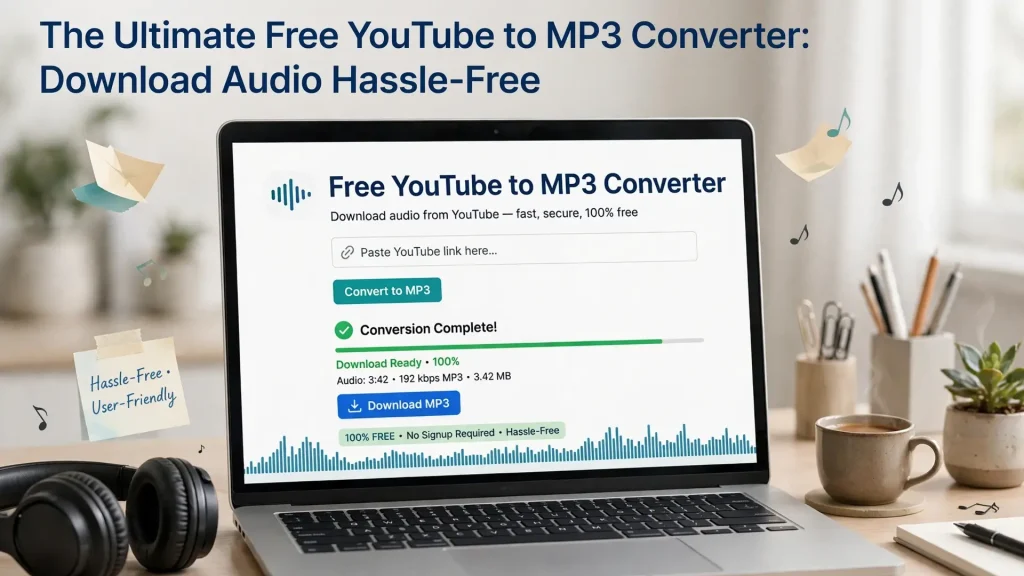
In today’s digital world, enjoying music, podcasts, lectures, and other audio content offline can be incredibly convenient. A YouTube to MP3 converter makes it possible to extract audio from eligible YouTube content and save it in a convenient format for offline listening.
Whether you’re commuting, exercising, traveling, or simply looking for a way to listen without an internet connection, a reliable converter can make the process quick and straightforward. The best free tools focus on simplicity, speed, audio quality, and ease of use—without requiring complicated installations or subscriptions.
Why Use a Free YouTube to MP3 Converter?
YouTube offers an enormous selection of music, podcasts, interviews, educational material, and other audio-rich content. However, streaming isn’t always practical when you have limited connectivity or want to listen offline.
A free YouTube to MP3 converter can provide a convenient alternative for content you’re authorized to download. Compared with methods such as screen recording, dedicated conversion tools can offer a simpler workflow and more practical audio files.
Some of the advantages include:
- Free access: Many online converters can be used without a subscription.
- Simple operation: Most require only a URL and a few clicks.
- Audio-quality options: Depending on the service and source, different bitrate options may be available.
- Cross-device compatibility: MP3 files can generally be played on computers, smartphones, tablets, and compatible car audio systems.
- Convenient offline listening: Save eligible content for situations where an internet connection isn’t available.
How a YouTube to MP3 Converter Works
Using a converter is typically straightforward. You copy the URL of an eligible YouTube video, paste it into the converter, choose an available audio format or quality setting, and begin the conversion.
The service processes the video and extracts its audio track, producing a downloadable audio file. Conversion speed and available quality depend on factors such as the source video, server capacity, and the particular converter you use.
Step-by-Step Guide
1. Find the Content
Open YouTube and locate the video containing the audio you want to save. Make sure you have permission to download and convert the content.
2. Copy the URL
Use YouTube’s sharing options to copy the video’s URL.
3. Paste the Link
Open your chosen converter and paste the URL into its input field.
4. Select an Available Format
Choose MP3 if it is supported, along with an appropriate quality setting. Higher bitrates generally produce larger files and do not necessarily improve quality beyond that of the original source.
5. Start the Conversion
Click the conversion or download button and wait for the process to finish.
6. Save the File
Once conversion is complete, download the resulting audio file to your device.
Features to Look For in a Free Converter
Not every online converter provides the same experience. When evaluating one, consider the following features:
- Straightforward interface: A clean design makes the process easier for beginners.
- Reasonable conversion speeds: Faster processing is particularly useful for longer videos.
- Multiple quality options: Flexible settings allow you to balance audio quality and file size.
- Broad device compatibility: Downloaded files should work with common media players.
- Privacy-conscious practices: Look for services that clearly explain how user data is handled.
- Secure connections: HTTPS should be used when transmitting information between your browser and the website.
- Minimal interruptions: Excessive pop-ups and misleading download buttons can make some free services frustrating to use.
Playlist and Batch Conversion
Some conversion services offer playlist or batch-processing functionality. This can be useful when you have several eligible videos to convert and want to avoid processing each URL individually.
Before using such features, check the service’s terms and make sure you have the necessary rights to download the content in question.
Understanding Audio Quality
MP3 quality is commonly expressed in kilobits per second (kbps). Higher bitrates generally require more storage space, but a higher number does not automatically mean better sound.
For example, converting a low-quality source to 320kbps will not restore audio detail that was absent from the original recording. Choosing a quality level that matches the source is therefore often more sensible than simply selecting the highest available setting.
Legal and Copyright Considerations
Using a YouTube to MP3 converter does not automatically grant permission to download copyrighted material.
The safest uses generally involve content that you created yourself, material that is explicitly licensed for downloading, public-domain works, or content for which you have permission from the copyright holder. YouTube’s terms and applicable copyright laws may also restrict downloading or converting certain content.
Before converting a video, make sure your intended use complies with the rights associated with that material.
YouTube to MP3 Converter vs. Other Options
Different approaches have different advantages and limitations:
| Option | Convenience | Installation | Audio Extraction |
|---|---|---|---|
| Online converter | High | Usually none | Yes |
| Desktop software | Moderate | Required | Yes |
| Screen recording | Moderate | Often available natively | Indirect |
| Official offline features | High | None | Depends on service |
For occasional conversions of content you are permitted to download, an online converter can be convenient. For frequent or more advanced workflows, dedicated software may provide additional control.
Common Uses for Offline Audio
When the necessary rights are in place, converted audio can be useful for a variety of purposes:
- Podcasts and educational content: Listen during travel or when connectivity is limited.
- Language-learning material: Practice lessons repeatedly without streaming.
- Personal recordings: Keep copies of your own published videos in an audio format.
- Royalty-free music: Create offline playlists from appropriately licensed sources.
- Lectures and presentations: Review educational material while away from an internet connection.
Troubleshooting Common Problems
If a conversion doesn’t work, a few basic checks can help:
- The video cannot be found: Confirm that the URL is correct and that the content is publicly accessible.
- Conversion takes too long: Longer videos and busy servers can increase processing time.
- The output sounds poor: Remember that the converted file cannot exceed the quality of the original audio source.
- The download button doesn’t work: Try refreshing the page or using a different supported browser.
- Unexpected pop-ups appear: Avoid clicking suspicious advertisements or download prompts and consider using a more reputable service.
The Future of Audio Conversion
As online video platforms continue to evolve, conversion services are likely to focus on faster processing, improved compatibility, and support for additional media formats.
At the same time, users should remain aware of copyright requirements, platform policies, privacy practices, and online security when using third-party conversion services.
Conclusion
A free YouTube to MP3 converter can be a convenient way to create offline audio files from content you are authorized to download. With a simple URL-based workflow, flexible quality settings, and broad device compatibility, these tools can make offline listening more accessible.
The key is to choose a service carefully, prioritize security and privacy, and always respect copyright and platform rules. Used responsibly, audio conversion can be a practical addition to your digital media toolkit.
Leave a Reply